Exploring the pervasive impact of per- and polyfluoroalkyl substances on
human health and the environment.
Abstract
Per- and polyfluoroalkyl substances (PFAS) are synthetic chemicals
widely used for their durability and resistance to heat, water, and oil.
Referred to as "forever chemicals," PFAS are linked to environmental
contamination and health concerns, including cancer and developmental
delays. This webpage synthesizes recent research on PFAS, exploring
their sources, exposure routes, health impacts, and global efforts to
mitigate their risks.
Sources of PFAS
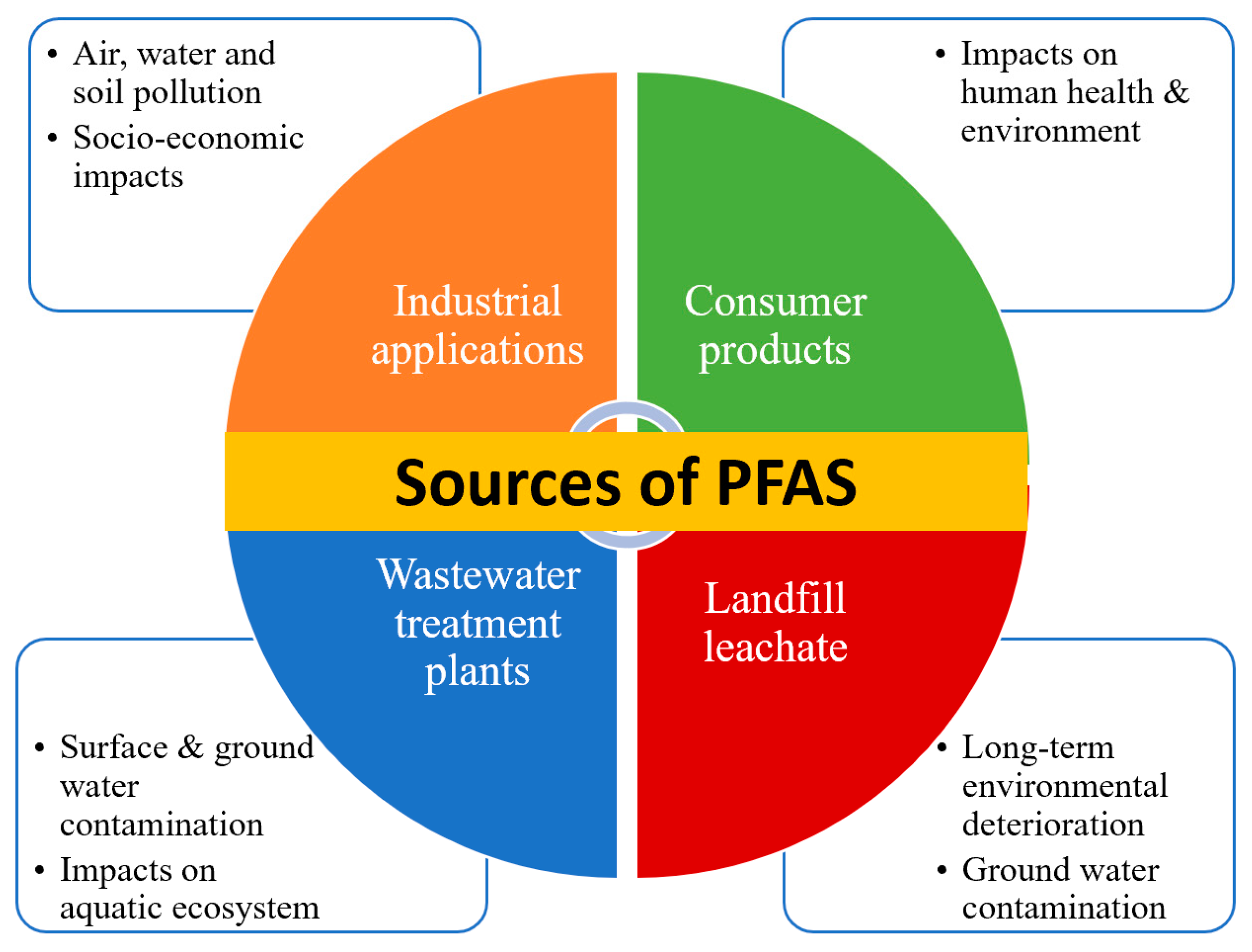
PFAS enter the environment through various pathways:
Industrial facilities producing firefighting foams, textiles, or
coatings (EPA, 2020).
Consumer products like nonstick cookware, fast-food packaging, and
cosmetics (Johansson et al., 2021).
Improperly managed waste disposal and leachate from landfills.
Wastewater treatment plants, which fail to fully filter PFAS (Liu et
al., 2020).
Image Source: Habib et al. (2024). Retrieved from
MDPI Pollutants.
Routes of Exposure
Humans are exposed to PFAS through:
Drinking water contaminated by industrial runoff or firefighting foam
(EPA, 2020).
Consumption of fish and produce grown in contaminated water or soil.
Inhalation of PFAS particles from indoor dust or industrial emissions
(Liu et al., 2020).
Direct contact with PFAS-containing products (Johansson et al., 2021).
PFAS Sources
Water Contamination
Drinking water contaminated by PFAS near industrial sites or
firefighting foam usage.
Food
Consumption of fish, dairy, or other foods exposed to PFAS in
water or packaging.
Consumer Products
Exposure through products like non-stick cookware, stain-resistant
fabrics, and cosmetics.
Human Exposure
PFAS accumulate in the body, leading to potential health risks.
Health Impacts of PFAS Exposure
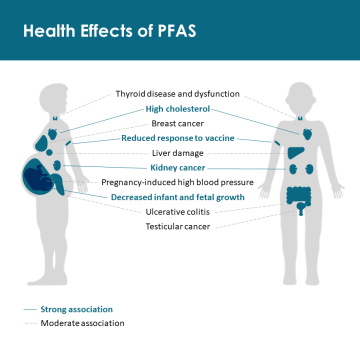
PFAS exposure has been associated with various adverse health effects,
including:
Increased cholesterol levels.
Immune system suppression (Salter et al., 2019).
Reduced fertility and pregnancy-related complications.
Developmental effects in children, including low birth weight
(Johansson et al., 2021).
Increased risk of cancers (e.g., kidney and testicular) (Liu et al.,
2020).
Thyroid hormone disruption (Salter et al., 2019).
These impacts have been observed in populations with high PFAS exposure,
such as communities near contaminated water sources and industrial
facilities (EPA, 2020).
Regulating PFAS usage through policies like the EPA's PFAS Action Plan
(EPA, 2020).
Developing filtration technologies, such as granular activated carbon
and reverse osmosis systems (Salter et al., 2019).
Encouraging the development of PFAS-free alternatives for industrial
applications.
Educating the public about safer consumer choices.
Identify PFAS Sources
↓
Implement Regulatory Controls
↓
Improve Water Treatment
↓
Promote Public Awareness
↓
Encourage Safer Alternatives
↓
Support Research and Innovation
Global Impact
PFAS contamination has emerged as a significant global issue, impacting
human health and the environment across continents. These synthetic
chemicals, often referred to as "forever chemicals" due to their
persistent nature, have been widely used in various industrial and
consumer products, leading to widespread environmental contamination.
The global impact of PFAS can be examined through several key
dimensions:
Environmental Impact
Soil and Water Contamination: PFAS have been detected
in soil and water sources around the world, particularly in regions
near manufacturing facilities and military bases. Groundwater near
these sites can contain PFAS levels exceeding safety standards,
affecting local ecosystems and drinking water supplies (Gauthier et
al., 2020).
Wildlife: PFAS accumulation in wildlife can disrupt
the endocrine system of various species, affecting reproduction and
development (Baker et al., 2020). Bioaccumulation in food chains poses
a risk to predators, including humans, who consume contaminated fish
and game.
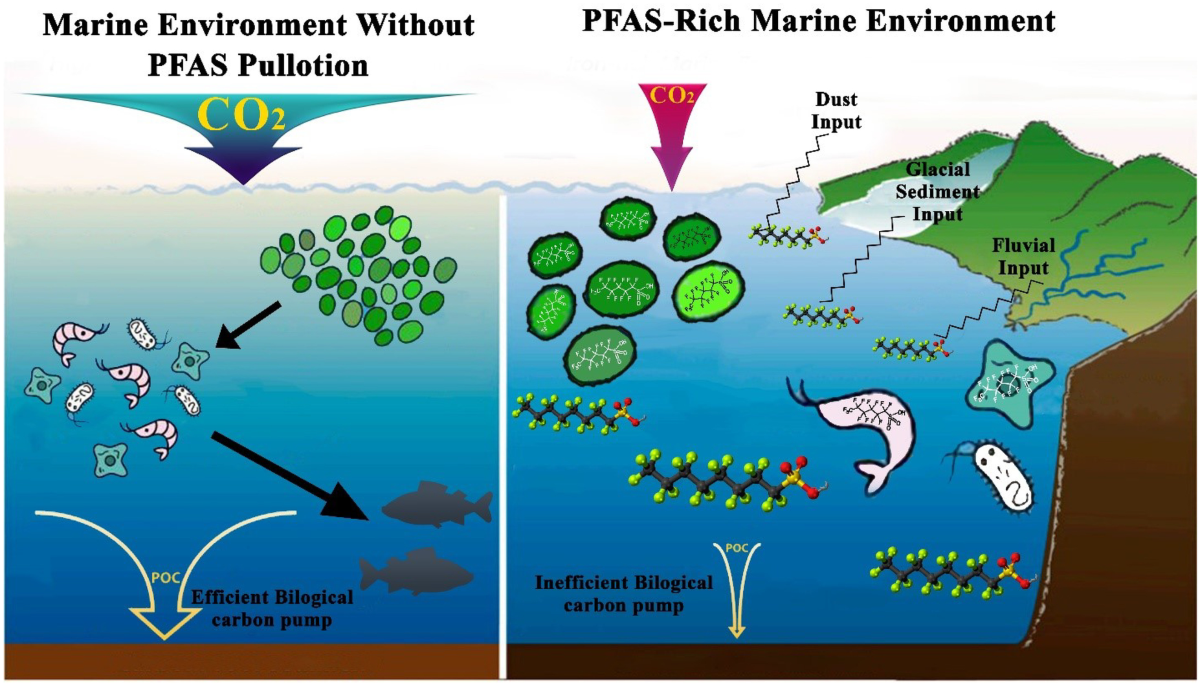
Global Transport: PFAS can be transported over long
distances through water and air, leading to contamination in remote
areas, such as the Arctic (Gouin et al., 2018).
Image Source: Mahmoudnia (2023). Retrieved from
Springer Nature.
Economic Impact
Water Treatment Costs: The presence of PFAS in
drinking water has significant economic implications for
municipalities. Upgrading water treatment facilities can incur
substantial costs (EPA, 2021).
Public Health Expenditures: Health effects associated
with PFAS exposure can lead to increased public health spending for
monitoring and medical costs (Land et al., 2020).
Legal and Liability Issues: Companies face increasing
legal challenges and liability claims related to PFAS contamination,
impacting corporate profitability (Vandenberg et al., 2016).
Social Implications
Public Awareness and Advocacy: Growing awareness of
PFAS contamination has led to increased advocacy and demand for
regulatory action (Scheringer et al., 2020).
Regulatory Responses: Governments worldwide are
beginning to respond to the PFAS crisis by implementing stricter
regulations (European Chemicals Agency, 2021).
Health Disparities: Vulnerable populations are often
disproportionately affected by PFAS contamination, exacerbating
existing health disparities (Brown et al., 2020).
The global impact of PFAS is profound and multifaceted, touching on
environmental, economic, and social issues. As awareness grows and
research continues to uncover the extent of contamination, it is crucial
for governments, industries, and communities to work together to address
the challenges posed by these persistent pollutants.
Conclusion
PFAS pose a significant risk to human health and the environment.
Continued research and public awareness are vital for addressing these
challenges.
References
Baker, J. E., & others. (2020). PFAS Accumulation in Wildlife: Effects
on Ecosystems. Environmental Toxicology and Chemistry, 39(3),
751-762.
Link
Brown, P., & others. (2020). The Social Implications of PFAS
Contamination: Health Disparities and Environmental Justice.
Journal of Environmental Health, 82(2), 36-43.
Link
EPA. (2020). PFAS Action Plan: Addressing PFAS contamination.
U.S. Environmental Protection Agency.
Link
European Chemicals Agency. (2021). Proposal to Restrict PFAS.
Link
Gauthier, J., & others. (2020). Contaminated Groundwater: The PFAS
Challenge. Water Research, 175, 115675.
Link
Gouin, T., & others. (2018). Environmental Fate of PFAS: Long-Range
Transport. Environmental Science & Technology, 52(5),
2673-2681.
Link
Habib, Z., Song, M., Ikram, S., & Zahra, Z. (2024). Overview of per-
and polyfluoroalkyl substances (PFAS), their applications, sources,
and potential impacts on human health. Pollutants, 4(1),
136–152.
Link
Johansson, P., Schmidt, N., & Jensen, S. (2021). Routes of PFAS
exposure and their effects on human health: A review.
Environmental Health Perspectives, 129(10), 106-119.
Link
Land, M., & others. (2020). Public Health Costs Associated with PFAS
Exposure. Journal of Public Health Management and Practice,
26(3), 233-239.
Link
Liu, J., Zhou, L., & Zhang, X. (2020). Health impacts of PFAS
exposure: A comprehensive review of environmental and human health
effects. Journal of Environmental Sciences, 47, 49-63.
Link
Mahmoudnia, A. (2023). The role of PFAS in unsettling ocean carbon
sequestration. Environmental Monitoring and Assessment, 195(2).
Link
PFAS & how they affect health. (2024, November 20). Public
Health Madison & Dane County.
Link
Salter, D. M., Williams, J. L., & Thomson, K. A. (2019). Mitigation
efforts to reduce PFAS exposure: Advances in filtration technologies
and policy recommendations. Science of the Total Environment,
710, 136283.
Link
Scheringer, M., & others. (2020). Community Activism and PFAS: A Call
for Action. Environmental Science & Policy, 114, 149-155.
Link
Vandenberg, L. N., & others. (2016). The Health Risks of PFAS: A
Review of Recent Studies. Environmental Research Letters,
11(12), 124023.
Link